Jerome a Paris has written an unusually forceful article denouncing the many doom and gloom scenarios that predict that an Iranian Oil Bourse (IOB) will bring the US dollar to its knees and starve western nations of oil. An article with a similar conclusion was written by Iranian academic Bahman Aghai Diba for the Persian Journal. These pieces insist that Iran lacks the legal and financial infrastructure to host international trading in oil.
These writers are missing a key point. They are assuming that oil will continue to trade freely, albeit perhaps at a much higher price. They assume that liquidity and transparancy will endure in the oil markets. But there may come a time when geologically driven oil shortages dry up liquidity in the oil markets. There may come a time when politically driven resource competition creates shortages in the oil markets. Liquidity will disappear when sellers in New York and London cannot guarantee delivery. It stands to reason that commodity markets function best, with great liquidity, when there is a plentiful supply of goods to trade. If there is a shortage, much less of that commodity will end up on the auction block. This is especially true for strategically critical commodities such as oil.
It hardly needs to be repeated that China is the most powerful buyer of commodities, and it has the biggest checkbook. Russia and Iran are key suppliers. These three countries are now the big shots at the poker table. The big shots do not have any commitment to open markets. They prefer backroom deals, made for strategic advantage, rather than securing the best price. One reason oil producing nations like Iran and Russia would have for keeping oil markets closed would be to exclude buyers they don't like. For example Americans.
America can still acquire oil, but only to the extent that other nations agree to finance its debt. Or America can use its military to try to secure its oil supply by threat, invasion or occupation. The American military itself consumes vast amounts of oil. Reducing American oil supplies would increase other nations' security (the nations that feel threatened by us) more than any military upgrade they could achieve. Note that it is in neither Russia's nor China's interest to cut off American oil supplies, nor bankrupt the USA. What is in their interest is that we are no longer a military super power.
It seems logical that China, Iran, and Russia will choose to set up an oil trading bourse, in Iran or elsewhere, that trades in Euros, or perhaps gold. Access to their market will be by invitation only. Private speculators, rude Americans, and those who don't honor Islam will be among the many who will be shut out of the party. Security, dispute resolution, and payment and delivery issues will not be settled in courts of law, but by the blessing and decree of the KGB, or the Iranian Revolutionary Council, or some such body.
Whether or not the Iranian Oil Bourse gets off the ground, don't expect the USA and Britain to be able to control oil trading much longer. They simply don't have the oil to trade.
Monday, February 27, 2006


Thursday, February 16, 2006
Alien Vs Predator
"Chevron's water rights for its DeBeque, Colo., shale oil project are leased, not sold, to the city of Las Vegas for drinking water. How will Las Vegas replace that in the future when Chevron won't extend the lease?" -- anonymous, via Byron King
This is funny! I was blogging about the stupidity and unsustainability of Las Vegas last year. Then I was blogging about a ludicrous shale oil boondoggle . Well it turns out that a significant part of Las Vegas' water supply come from water rights to the Colorado River that are owned by Chevron Oil. Chevron aquired the water rights when it bought a shale oil project! I read about this in a Whiskey & Gunpowder mail by Byron King. So I'm imagining two of the most wasteful, environmentally damaging enterprises, Vegas and oil shale production, fighting over water rights. Lets just hope they both lose and we start to think about sustainability. Fat chance.
Wednesday, February 15, 2006
Employment in Depletion
This is astounding. I quote from Paul Craig Roberts:
Original here at Counterpunch
I wonder if this is accurate? When the real estate bubble finally pops, will we wake up to the fact that we are not just beginning an economic depression, but that we are in the middle of one?
In the last five years, US manufacturing lost 2.9 million jobs, almost 17% of the manufacturing work force. The wipeout is across the board. Not a single manufacturing payroll classification created a single new job.
The declines in some manufacturing sectors have more in common with a country undergoing saturation bombing during war than with a super-economy that is “the envy of the world.” Communications equipment lost 43% of its workforce. Semiconductors and electronic components lost 37% of its workforce. The workforce in computers and electronic products declined 30%. Electrical equipment and appliances lost 25% of its employees. The workforce in motor vehicles and parts declined 12%. Furniture and related products lost 17% of its jobs. Apparel manufacturers lost almost half of the work force. Employment in textile mills declined 43%. Paper and paper products lost one-fifth of its jobs. The work force in plastics and rubber products declined by 15%. Even manufacturers of beverages and tobacco products experienced a 7% shrinkage in jobs.
The knowledge jobs that were supposed to take the place of lost manufacturing jobs in the globalized “new economy” never appeared. The information sector lost 17% of its jobs, with the telecommunications work force declining by 25%. Even wholesale and retail trade lost jobs. Despite massive new accounting burdens imposed by Sarbanes-Oxley, accounting and bookkeeping employment shrank by 4%. Computer systems design and related lost 9% of its jobs. Today there are 209,000 fewer managerial and supervisory jobs than 5 years ago.
Original here at Counterpunch
I wonder if this is accurate? When the real estate bubble finally pops, will we wake up to the fact that we are not just beginning an economic depression, but that we are in the middle of one?
Saturday, February 11, 2006
living in candyland
I find myself in a constant state of analysis and scepticism of society.
I look around me, I see the strip malls, the multiplicity of Starbucks, the credit cards, and I think: all is an illusion. Americans are living in Candyland now, and the candy will soon wash away in the rain. This city, and every city, will be full of empty stores in some number of years time, rotting evidence of our stupidity, waste and hubris. It is hard to watch history's largest train wreck occur, in slow motion, right before your eyes. It could be avoided, but instead we choose to charge full speed into the catastrophe of the Greatest Ever Depression.
What to do? My advice: buy gold and silver coins, get a sewing machine, get a garden. Make friends with your neighbors.
I look around me, I see the strip malls, the multiplicity of Starbucks, the credit cards, and I think: all is an illusion. Americans are living in Candyland now, and the candy will soon wash away in the rain. This city, and every city, will be full of empty stores in some number of years time, rotting evidence of our stupidity, waste and hubris. It is hard to watch history's largest train wreck occur, in slow motion, right before your eyes. It could be avoided, but instead we choose to charge full speed into the catastrophe of the Greatest Ever Depression.
What to do? My advice: buy gold and silver coins, get a sewing machine, get a garden. Make friends with your neighbors.
Friday, February 10, 2006
Latino vs Black
When times get tough, how quickly we descend into tribalism.
Another racial brawl breaks out Friday at LA jail
This is much like the type of social unrest Kunstler predicts for the USA on the downslope of peak oil. Don't think ethnic violence is unusual, or limited to jails. Read in Jared Diamond's Collapse about how resource scarcity caused the ethnic violence and genocide in Rwanda. All people can become viscious when threatened. How long did it take in New Orleans? Three days. White "deputies" with shotguns on a bridge were defending their town against a percieved invasion of mostly black refugees from New Orleans.
Another racial brawl breaks out Friday at LA jail
This is much like the type of social unrest Kunstler predicts for the USA on the downslope of peak oil. Don't think ethnic violence is unusual, or limited to jails. Read in Jared Diamond's Collapse about how resource scarcity caused the ethnic violence and genocide in Rwanda. All people can become viscious when threatened. How long did it take in New Orleans? Three days. White "deputies" with shotguns on a bridge were defending their town against a percieved invasion of mostly black refugees from New Orleans.
Thursday, February 09, 2006
It is not gloomy to say it, these are facts
I look to the great depression as a model for the next ten, twenty years. Gardening and sewing will be helpful, both of which I like to do, although I'm sloppy at both.
But there are big differences between the 30s and now. Back then we were self sufficient in energy, capital, and manufacturing. That was then. Now we have nothing. Except massive liabilities. It is not gloomy to say it, these are facts. Now I'll move on to some doom and gloom.
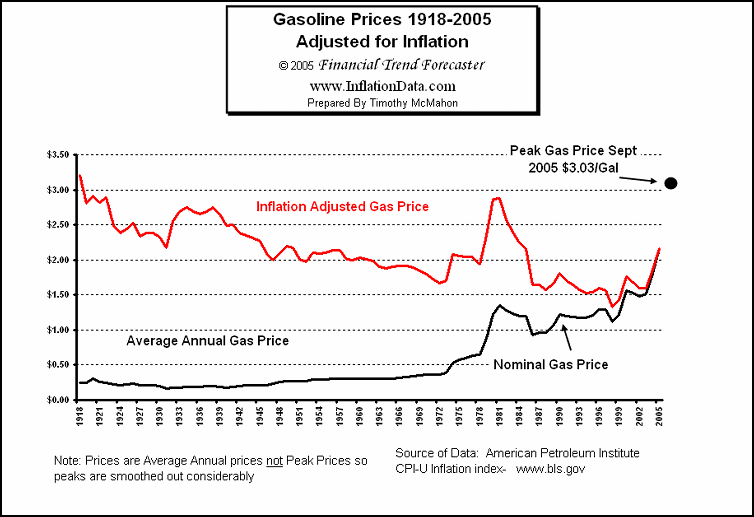
A friend said she'd lost the sense of impending doom that she had last summer. Sure. Energy and food are both cheap right now. Adjusted for the CPI, gasoline is close to its historical mean, and far cheaper than it was in the 1980s. As soon as prices go up, which is about as inevitable as anything, then a general sense of crisis will come back. I did appreciate Bush mentioning energy in his speech, economics of ethanol notwithstanding. Just because energy prices are at a temporary lull doesn't mean we should be complacent. And food! People have no idea. Corn is $2.30 for a 45 pound bushel! Just think about it, that is crazy. When corn goes to $6, and then $10, then see how many people are talking about ethanol and bio diesel. Hyperbolic rises in cotton, sugar, and wheat are also on their way. Food prices will hurt even more than energy prices, especially for low income people.
When gloomy, my friend considers moving to Idaho. I'm not convinced Idaho is a better place to be than Seattle. No way. Living around all those red-state wing nuts? Yelling "FAG" at me from their pickups?
Of course, if the gulf stream breaks up, at the same time that oil peaks and the dollar collapses (note that these things will exacerbate each other) it may just be game over. But lets not get ourselves down about this. Hey what's fate is fate. Oh, I forgot: pandemic bird flu might be another factor that could wipe us out..
But there are big differences between the 30s and now. Back then we were self sufficient in energy, capital, and manufacturing. That was then. Now we have nothing. Except massive liabilities. It is not gloomy to say it, these are facts. Now I'll move on to some doom and gloom.
A friend said she'd lost the sense of impending doom that she had last summer. Sure. Energy and food are both cheap right now. Adjusted for the CPI, gasoline is close to its historical mean, and far cheaper than it was in the 1980s. As soon as prices go up, which is about as inevitable as anything, then a general sense of crisis will come back. I did appreciate Bush mentioning energy in his speech, economics of ethanol notwithstanding. Just because energy prices are at a temporary lull doesn't mean we should be complacent. And food! People have no idea. Corn is $2.30 for a 45 pound bushel! Just think about it, that is crazy. When corn goes to $6, and then $10, then see how many people are talking about ethanol and bio diesel. Hyperbolic rises in cotton, sugar, and wheat are also on their way. Food prices will hurt even more than energy prices, especially for low income people.
When gloomy, my friend considers moving to Idaho. I'm not convinced Idaho is a better place to be than Seattle. No way. Living around all those red-state wing nuts? Yelling "FAG" at me from their pickups?
Of course, if the gulf stream breaks up, at the same time that oil peaks and the dollar collapses (note that these things will exacerbate each other) it may just be game over. But lets not get ourselves down about this. Hey what's fate is fate. Oh, I forgot: pandemic bird flu might be another factor that could wipe us out..
Thursday, February 02, 2006
George Bush on biomass
I don't often agree with our faux-Texan prez, but when he said that sawgrass, (and other low grade, high cellulose biomass products) could reduce our dependence on liquid fuel imports by 75% by 2025, well I thought that was pretty absurd. So did this analysis from the Christian Science Monitor. But then I thought maybe Bush is right after all, but probably not in the way he was thinking.
First off, I think peak oil is immanently upon us. The moment when this becomes accepted as unassailable fact will come when Saudi Arabia announces that the Gwahar oil field, the world's largest, is in irreversible decline. This will be similar to Kuwait's December '05 admission that their giant field, Burgan, is in decline. Saudi Arabia's announcement, which is close at hand, I believe, will be the world-changing event. But no matter when peak oil crosses the line from conspiracy theorist, malthusian doom to simple, obvious global reality, by 2025, we should assume and plan for a critical energy shortage. This is George Bush's date, not mine. I believe that our crisis will come much sooner: probably by 2010 the USA will be in a state of semi permanent energy crisis.
But looking 19 years ahead to 2025, we will be importing no oil from the middle east, simply because the middle east will be running thin on oil. Nations can go from energy exporters to energy importers very quickly. Indonesia made the switch in 2005. If the Middle East exports oil, it will go to China. Byron King makes this point in his essay The 75% Solution. The point being that today biomass looks pretty scrawny in comparison to gasoline. By 2025, gasoline, and owning one's own car, will exist mainly in our memories. Gasoline will be available only to military and government elites. But some vehicles will need to keep running, especially trucks and tractors and trains. Diesel will be available for commercial use, but it will be very expensive, with limited production coming from Canadian tar sands. But contrary to the Christian Science Monitor's writer's article, you can run your car on biomass, and at times when fuel has been scarce, many people have done exactly that. The equipment is simple and cheap.
Look at historical examples of severe fuel crisis. In parts of the world, there was virtually no civilian fuel available during world war II. In Scandinavia, Russia, and Australia fuel was unavailable at any price. The way that people in these countries found most expedient to keep cars running, and, significantly, agricultural production moving, was to install simple wood gasifiers on their vehicles. These cars can run directly on wood chips, compressed sawdust pellets, charcoal, etc. Here's another example. And a Seattle Times article about a backyard welder who built a gasifier to make a wood burning truck.
So, I'm thinking even the paltry amounts of money Bush proposed would go a long way in refining and publicizing this simple, proven method for operating vehicles on biomass. I imagine high cellulose products like sawgrass, compressed into pellets, or wood chips made from brush wood, would be more efficient to burn in a gasifier than try to distill into alcohol. Or, high-cellulose materials can be made into charcoal to make a more powerful fuel. These high cellulose biomass sources do not require nearly as much cultivation or fertilizer as corn. Most importantly, a local energy economy can be made from such biomass sources without huge sums of capital. Small producers can manufacture wood chips and pellets. Small shops can make gasifiers and install them. If we find that it is hard to raise the capital to build fleets of gigantic LNG tankers and the terminals to recieve them, then we may find that small biomass producers are not only a good way to keep people and goods moving, but also a good way to employ people.
Unfortunately, Bush cares in no way for energy efficiency. The research cash he spoke of will go either as hand outs to politically connected agribusiness corporations, or publicists posing as scientists to spin crises in favor of the republican agenda.
First off, I think peak oil is immanently upon us. The moment when this becomes accepted as unassailable fact will come when Saudi Arabia announces that the Gwahar oil field, the world's largest, is in irreversible decline. This will be similar to Kuwait's December '05 admission that their giant field, Burgan, is in decline. Saudi Arabia's announcement, which is close at hand, I believe, will be the world-changing event. But no matter when peak oil crosses the line from conspiracy theorist, malthusian doom to simple, obvious global reality, by 2025, we should assume and plan for a critical energy shortage. This is George Bush's date, not mine. I believe that our crisis will come much sooner: probably by 2010 the USA will be in a state of semi permanent energy crisis.
But looking 19 years ahead to 2025, we will be importing no oil from the middle east, simply because the middle east will be running thin on oil. Nations can go from energy exporters to energy importers very quickly. Indonesia made the switch in 2005. If the Middle East exports oil, it will go to China. Byron King makes this point in his essay The 75% Solution. The point being that today biomass looks pretty scrawny in comparison to gasoline. By 2025, gasoline, and owning one's own car, will exist mainly in our memories. Gasoline will be available only to military and government elites. But some vehicles will need to keep running, especially trucks and tractors and trains. Diesel will be available for commercial use, but it will be very expensive, with limited production coming from Canadian tar sands. But contrary to the Christian Science Monitor's writer's article, you can run your car on biomass, and at times when fuel has been scarce, many people have done exactly that. The equipment is simple and cheap.
Look at historical examples of severe fuel crisis. In parts of the world, there was virtually no civilian fuel available during world war II. In Scandinavia, Russia, and Australia fuel was unavailable at any price. The way that people in these countries found most expedient to keep cars running, and, significantly, agricultural production moving, was to install simple wood gasifiers on their vehicles. These cars can run directly on wood chips, compressed sawdust pellets, charcoal, etc. Here's another example. And a Seattle Times article about a backyard welder who built a gasifier to make a wood burning truck.
So, I'm thinking even the paltry amounts of money Bush proposed would go a long way in refining and publicizing this simple, proven method for operating vehicles on biomass. I imagine high cellulose products like sawgrass, compressed into pellets, or wood chips made from brush wood, would be more efficient to burn in a gasifier than try to distill into alcohol. Or, high-cellulose materials can be made into charcoal to make a more powerful fuel. These high cellulose biomass sources do not require nearly as much cultivation or fertilizer as corn. Most importantly, a local energy economy can be made from such biomass sources without huge sums of capital. Small producers can manufacture wood chips and pellets. Small shops can make gasifiers and install them. If we find that it is hard to raise the capital to build fleets of gigantic LNG tankers and the terminals to recieve them, then we may find that small biomass producers are not only a good way to keep people and goods moving, but also a good way to employ people.
Unfortunately, Bush cares in no way for energy efficiency. The research cash he spoke of will go either as hand outs to politically connected agribusiness corporations, or publicists posing as scientists to spin crises in favor of the republican agenda.
Friday, January 27, 2006
Kuwait's oil reserves
Kuwait has let it be known, through the mouthpiece of an oil industry newsletter, the Petroleum Intelligence Weekly, that its oil reserves are less than half of what had been previously stated. Last week Kuwait possessed 99 billion barrels of oil. This week it has only 48 billion barrels. As Byron King points out in his newsletter Whiskey and Gunpowder, this amounts to a 5% reduction in global oil reserves.
Of course it has been suspected for many years that OPEC countries' oil reserves have been over stated by 50%. This is the first official confirmation. If Saudi Arabia follows suit, it will confirm (Saudi oil magnates' nemesis) Matthew Simmons' thesis that the Saudi kingdom is near peak also.
Why is it in OPEC nations' interest to restate their reserves now? Maybe because times have changed. When these countries overstated their reserves, it was a buyers market in oil. Oil producers were suffering from falling energy prices. A larger reserve base meant a larger production quota, and greater revenue.
Now things are different. All OPEC countries are finding it hard to meet their production quotas for light oil. This stuff has become extremely valuable all of a sudden. Countries that possess large reserves of it have to think about defending their territory against the possibility of invasion. It would be safer to emphasize how little oil a small nation has, rather than how much.
It has also become clear that faster production means that a smaller percentage of the entire oilfeild will be recoverable in the end. Slower production preserves the geological integrity of the oilfeild. Few countries now are trying to maximize their production. Nations are now trying to steward their natural resources carefully, not sell them off as quickly as possible.
Import dependant countries, like the USA, Japan, China, Europe are making increasingly desperate pleas for more oil production, which are mostly going unheard. China is backing up its pleading with very large cash and military protection offers. The USA is mainly backing up its pleading with threat of invasion. When asked, the Saudis typically announce that they will increase production, but they never do. Instead they offer heavy sour oil, of which there is a glut on the maket, and few refineries can process.
I bet more coutries will follow Kuwait's lead in restating official reserves this year.
Of course it has been suspected for many years that OPEC countries' oil reserves have been over stated by 50%. This is the first official confirmation. If Saudi Arabia follows suit, it will confirm (Saudi oil magnates' nemesis) Matthew Simmons' thesis that the Saudi kingdom is near peak also.
Why is it in OPEC nations' interest to restate their reserves now? Maybe because times have changed. When these countries overstated their reserves, it was a buyers market in oil. Oil producers were suffering from falling energy prices. A larger reserve base meant a larger production quota, and greater revenue.
Now things are different. All OPEC countries are finding it hard to meet their production quotas for light oil. This stuff has become extremely valuable all of a sudden. Countries that possess large reserves of it have to think about defending their territory against the possibility of invasion. It would be safer to emphasize how little oil a small nation has, rather than how much.
It has also become clear that faster production means that a smaller percentage of the entire oilfeild will be recoverable in the end. Slower production preserves the geological integrity of the oilfeild. Few countries now are trying to maximize their production. Nations are now trying to steward their natural resources carefully, not sell them off as quickly as possible.
Import dependant countries, like the USA, Japan, China, Europe are making increasingly desperate pleas for more oil production, which are mostly going unheard. China is backing up its pleading with very large cash and military protection offers. The USA is mainly backing up its pleading with threat of invasion. When asked, the Saudis typically announce that they will increase production, but they never do. Instead they offer heavy sour oil, of which there is a glut on the maket, and few refineries can process.
I bet more coutries will follow Kuwait's lead in restating official reserves this year.
Thursday, January 26, 2006
strife at the plateau of oil production
Peak oil is not just about how much oil is produced, but also:
1. who gets it
2. who finances it, and in what currency
Strategic power is forcefully shifting east, to Russia, Iran and China. Jim Willie just wrote a killer essay on the geopolitics of oil. I quote Willie on why the USA cannot attack Iran to control its oil fields, like it did to Iraq:
If oil does not actually peak in the next five years, but production follows a bumpy plateau, the key question will be "who gets it"? If the USA gets less and China gets more, then there will be a major change in the relative prosperity of those nations. Also, Putin's Russia is becoming very strong, controlling most of Europe's access to energy.
If the worldwide banking and trading markets shift to Euros, which is something Putin wants, this could bring severe changes also. Our bankers would probably lend us enough cash to stay solvent, but require reductions in our defense budget..
1. who gets it
2. who finances it, and in what currency
Strategic power is forcefully shifting east, to Russia, Iran and China. Jim Willie just wrote a killer essay on the geopolitics of oil. I quote Willie on why the USA cannot attack Iran to control its oil fields, like it did to Iraq:
The Iranian Oil Exchange challenges the Petro-Dollar. This time it is different. Iran aint Iraq. Iran has two big friends who have a good memory of recent heavy-handed dealings. When the United States invaded Iraq, established the reconstruction, and began to install a new government, it did so with little resistance. In the process two big events took place, not mentioned much by the lapdog US press & media. Russia got screwed out of multiple billion$ in Iraqi debt. China got screwed out of multiple billion$ in large energy contracts for Iranian oil & gas....
By enlisting Russian and Chinese assistance militarily, Iran has won some effective defense. Clearly, Russia is the key participant, but not without China supplying key Silkworm missiles themselves. Recall Putin is a master chess player. Russia recently announced the sale of world class missile systems to Iran. Be sure that overtaking Iraq was akin to taking the lunch pail from a 7-yr old boy sitting for a school bus. Overtaking Iran bears no resemblance to Iraq. Iran has over 70 million people, as opposed to Iraq's 23 million. Iran has no easy borders and no friendly neighbor for the US to base an attack. The "shock & awe" was mere target practice and an exercise of advanced weaponry on largely undefended sites...
If oil does not actually peak in the next five years, but production follows a bumpy plateau, the key question will be "who gets it"? If the USA gets less and China gets more, then there will be a major change in the relative prosperity of those nations. Also, Putin's Russia is becoming very strong, controlling most of Europe's access to energy.
If the worldwide banking and trading markets shift to Euros, which is something Putin wants, this could bring severe changes also. Our bankers would probably lend us enough cash to stay solvent, but require reductions in our defense budget..
Wednesday, January 25, 2006
innovation is overrated..
In the business pages I read companies bragging about innovation, ad nauseum. Their own innovation of course. Most ludicrous of all is Microsoft. Microsoft says innovation is their one true "core competancy". Bill Gates even says his position in the company is "chief innovator". Naturally companies can be expected to brag and bluster, but Microsoft innovative?
The problem is larger than an annoying business buzword. It is a philosophical assumption that innovation is always good, that there is no downside, that there is no cost nor drawback to innovation. A free lunch. Society, and particularly progress, depends on innovation. It is a freight train that can not slow down. If it did, then the unthinkable would have to be thought. The freight train of progress must, by definition, make the world a better place. Technology is widely admired. The myth is that it will make our lives easier and give us more free time. Like an ad for a handheld computer, showing a person in office attire using a gadget at the beach - technology has set the person free! The reality is exactly the opposite. Nobody goes to the beach more often because innovative technology has given them more free time. Innovation means working more hours, not less. We also assume that innovation is that proverbial rising tide that floats all boats. That everyone will benefit. But inconveniently, disparity of wealth is growing, not shrinking. The technocrats' answer is of course: more innovation.
We should be aware of what is lost with innovation. That is tradition. In America we are accustomed to despise tradition, we are so eager to replace it with something better, a more profitable, faster, bigger thing or way of doing. Accounting standards are a good example. Enron was among the companies that was applauded for innovative accounting in the 1990s. When Enron fell apart the innovation was relabled: fraud. The same thing might be said for fiat currency itself some day. It was a wonderful thing. Until it crashed. Then we might think there was a good reason that money was, traditionally, made from silver and gold.
The problem is larger than an annoying business buzword. It is a philosophical assumption that innovation is always good, that there is no downside, that there is no cost nor drawback to innovation. A free lunch. Society, and particularly progress, depends on innovation. It is a freight train that can not slow down. If it did, then the unthinkable would have to be thought. The freight train of progress must, by definition, make the world a better place. Technology is widely admired. The myth is that it will make our lives easier and give us more free time. Like an ad for a handheld computer, showing a person in office attire using a gadget at the beach - technology has set the person free! The reality is exactly the opposite. Nobody goes to the beach more often because innovative technology has given them more free time. Innovation means working more hours, not less. We also assume that innovation is that proverbial rising tide that floats all boats. That everyone will benefit. But inconveniently, disparity of wealth is growing, not shrinking. The technocrats' answer is of course: more innovation.
We should be aware of what is lost with innovation. That is tradition. In America we are accustomed to despise tradition, we are so eager to replace it with something better, a more profitable, faster, bigger thing or way of doing. Accounting standards are a good example. Enron was among the companies that was applauded for innovative accounting in the 1990s. When Enron fell apart the innovation was relabled: fraud. The same thing might be said for fiat currency itself some day. It was a wonderful thing. Until it crashed. Then we might think there was a good reason that money was, traditionally, made from silver and gold.
Friday, January 20, 2006
I love it!!
"The market rout came as energy prices surged and as key technology stocks disappointed"
- MarketWatch
- MarketWatch
Wednesday, January 11, 2006
Not Shale Oil Again!!
I bet we'll be hearing more about shale oil, or Kerogen, this year. Canadian Tar Sand had a very profitable year in '05, thanks to a massive marketing campaign to promote Canada as the Saudi Arabia of the future. This year Colorado's shale will want some of that action. Really, all kerogen has going for it is that it is American. So, we can at least dream of energy independence. And some people will want to invest in that. I've thought for a while that it won't work, for a shortage of water, for one, and a very low return on energy.
Now Shell Oil has a particularly preposterous, and seductively innovative, plan to produce oil from shale. They intend to heat Colorado earth to 650 degrees F, from the surface to 1000 feet down, and let it cook for three or four years. This will turn the kerogen into light free-flowing oil! Lots of natural gas is also produced, which can be recovered, and many bi-products, which are mostly toxic. So that the oil doesn't escape (and pollute groundwater) they plan to construct a "freeze wall". This is a huge box of frozen earth that contains the boiling earth. They plan to do this for up to 1000 square miles!
Its hard to even imagine the environmental consequences of such madness. I read about this scheme in Dan Denning's Strategic Investment newsletter (I would link, but it is subscription only). My first reaction was that this would never work out, so why worry? But then I thought of all the people who are desperate to find the "next energy source", and the people who are desperate to achieve "energy independence", and the people who are simply desperate to get rich on any scheme no matter how stupid. And then I thought of how easily Shell and other oil companies will be able to raise billions of dollars just by making classy presentations (they will make presentations to everyone except the hapless residents of the shale country, who will have their land and health taken from them). And then the oil companies will have to do something with the dollars that they raise. They will have to go make a gigantic mess in Colorado. They will destroy what little, and very precious, groundwater there is in those high arid plains. Then naturally the whole thing will go bankrupt amid financial scandals.
So I just hope, as it becomes more obvious that we are facing peak energy, and we look to the future, and as our dollar starts its long final slide to irrelevance, that we do sensible things with the last of our capital and energy, not blow it on a dangerously idiotic shale oil boondoggle. Lets think about re-building America's rail system. There is a lot that we could fix in this country. No need to boil up Colorado.
Now Shell Oil has a particularly preposterous, and seductively innovative, plan to produce oil from shale. They intend to heat Colorado earth to 650 degrees F, from the surface to 1000 feet down, and let it cook for three or four years. This will turn the kerogen into light free-flowing oil! Lots of natural gas is also produced, which can be recovered, and many bi-products, which are mostly toxic. So that the oil doesn't escape (and pollute groundwater) they plan to construct a "freeze wall". This is a huge box of frozen earth that contains the boiling earth. They plan to do this for up to 1000 square miles!
Its hard to even imagine the environmental consequences of such madness. I read about this scheme in Dan Denning's Strategic Investment newsletter (I would link, but it is subscription only). My first reaction was that this would never work out, so why worry? But then I thought of all the people who are desperate to find the "next energy source", and the people who are desperate to achieve "energy independence", and the people who are simply desperate to get rich on any scheme no matter how stupid. And then I thought of how easily Shell and other oil companies will be able to raise billions of dollars just by making classy presentations (they will make presentations to everyone except the hapless residents of the shale country, who will have their land and health taken from them). And then the oil companies will have to do something with the dollars that they raise. They will have to go make a gigantic mess in Colorado. They will destroy what little, and very precious, groundwater there is in those high arid plains. Then naturally the whole thing will go bankrupt amid financial scandals.
So I just hope, as it becomes more obvious that we are facing peak energy, and we look to the future, and as our dollar starts its long final slide to irrelevance, that we do sensible things with the last of our capital and energy, not blow it on a dangerously idiotic shale oil boondoggle. Lets think about re-building America's rail system. There is a lot that we could fix in this country. No need to boil up Colorado.
Monday, January 09, 2006
Inflation in 2006
In the current Newsweek issue (January 9), Robert J. Samuelson says that 2006 will be a boring but moderately prosperous year IF nothing very bad happens to the US economy. Then he goes on to list 5 things that could derail the economy and send presumably it into recession. The five things are:
Housing goes bust
The dollar crashes
General Motors files for bankruptcy
Oil jumps to $85 a barrel
The yield curve inverts
He did not see the need to ponder what would happen if all five things happen in the coming year. The all seem likely to me anyway. Except maybe the last item - I have no idea if yield curve will invert (I have tried to figure this one out. All it says to me is that the Fed is not in control. They want to raise interest rates, but they can only raise the short term rate, and the long term rate, set by the market, remains stubbornly low). But a housing market bust? virtually certain. The re-finance industry will come to a complete halt. Oil going to $85? Also near certain. And if a dollar buys that much less oil, and the liquidity in housing dissapears, then yes, the dollar will fall.
There are some other dark clouds on the horizon that Samuelson didn't mention. War with Iran. This is looking more and more likely. Can there be anything more threatening? This would be the very worst thing at the worst time.
A dark horse that no one seems to be thinking about is that commodity price inflation will spread from oil to such basic goods as corn, cotton, and soybeans. For now people seem to take it for granted that grains and other soft commodities will always be available at very cheap prices. I mean $2.20 for 50 pounds of corn??? I think corn will double this year and then double again next year. And corn is used to make many thousands of products. Same for soybeans. For years now the prices of these commodities have been held down by globalization: cheap production could always be found somewhere, like Brazil, Eastern Europe, if not America or Canada. But now the key factor in agricultural production is fuel and fertilizer (which is linked to natural gas) prices. These costs are going up worldwide, giving a very stong inflationary push to the dollar.
He did not see the need to ponder what would happen if all five things happen in the coming year. The all seem likely to me anyway. Except maybe the last item - I have no idea if yield curve will invert (I have tried to figure this one out. All it says to me is that the Fed is not in control. They want to raise interest rates, but they can only raise the short term rate, and the long term rate, set by the market, remains stubbornly low). But a housing market bust? virtually certain. The re-finance industry will come to a complete halt. Oil going to $85? Also near certain. And if a dollar buys that much less oil, and the liquidity in housing dissapears, then yes, the dollar will fall.
There are some other dark clouds on the horizon that Samuelson didn't mention. War with Iran. This is looking more and more likely. Can there be anything more threatening? This would be the very worst thing at the worst time.
A dark horse that no one seems to be thinking about is that commodity price inflation will spread from oil to such basic goods as corn, cotton, and soybeans. For now people seem to take it for granted that grains and other soft commodities will always be available at very cheap prices. I mean $2.20 for 50 pounds of corn??? I think corn will double this year and then double again next year. And corn is used to make many thousands of products. Same for soybeans. For years now the prices of these commodities have been held down by globalization: cheap production could always be found somewhere, like Brazil, Eastern Europe, if not America or Canada. But now the key factor in agricultural production is fuel and fertilizer (which is linked to natural gas) prices. These costs are going up worldwide, giving a very stong inflationary push to the dollar.
Tuesday, December 20, 2005
On Strike!
I was just talking to my brother Steve, who lives in New York City, about the transit workers' strike. He was saying how great it was to see so many people out bicycling and rollerblading to work, but that it was also a big pain in the ass. He did not support the transit workers, by any means. After telling me the basic outlines of the union demands, he made a convincing argument that it was an unfair stike by greedy workers. I have not heard the whole situation and I'm not making a judgement, but for the moment lets assume that yes, NYC transit workers are greedy.
So what? Did greed become a shameful thing in America all of a sudden? If so, is it bad to be a greedy rich person, or is it only bad to be a greedy blue collar person? We are so accustomed to huge gains in wealth and capital for the already rich, and so accustomed to the working person working longer hours for less pay and threatened with layoff, that we have lost all perspective. The investment manager being rewarded with 50 million dollars for a years work is fêted, but the transit worker demanding better wages is villified. There is no fundamental reason why some should be paid one thousand times what others are paid - and this is a very large part of the problems this country faces. Steve tells me that NYC cops start out at $25,000/year. That seems amazingly low. I wonder what grade school teachers get?
Many transit jobs are highly specialized, such as maintaining rail cars and underground track. I know that rail freight company Burlington Northern is struggling to keep its track in shape, and trains are running at capacity. Rail workers are hard to find right now. If new workers are hard to find and train, then that would give the current union employees lots of bargaining power. Since the NYC transit system cannot be moved offshore to China, then NYC will simply have to settle at a disadvantage. Transit workers may well gain higher pay, better benefits, and status. In this country status always comes with money.
But will the NYC transit union get away with their stike, and successfully improve workers' contracts? Unions have had very little real power in decades, and stikes rarely pay off. If the tables do turn, and blue collar unions come back into an age of power, then I don't see any reason to expect them not to be "greedy", I would expect them to try to get as much as they can, since that has been the American way for generations.
P.S. I should add that stikes are, by definition, symptoms of a disfunctional economy. Strikes crippled Boeing in the 1990s (not that Boeing deserves any sympathy). Strikes rarely produce economic benefits for societies. But for what its worth, it is better to have strikes than riots, which is what we'll be getting next if things don't get more equitable.
So what? Did greed become a shameful thing in America all of a sudden? If so, is it bad to be a greedy rich person, or is it only bad to be a greedy blue collar person? We are so accustomed to huge gains in wealth and capital for the already rich, and so accustomed to the working person working longer hours for less pay and threatened with layoff, that we have lost all perspective. The investment manager being rewarded with 50 million dollars for a years work is fêted, but the transit worker demanding better wages is villified. There is no fundamental reason why some should be paid one thousand times what others are paid - and this is a very large part of the problems this country faces. Steve tells me that NYC cops start out at $25,000/year. That seems amazingly low. I wonder what grade school teachers get?
Many transit jobs are highly specialized, such as maintaining rail cars and underground track. I know that rail freight company Burlington Northern is struggling to keep its track in shape, and trains are running at capacity. Rail workers are hard to find right now. If new workers are hard to find and train, then that would give the current union employees lots of bargaining power. Since the NYC transit system cannot be moved offshore to China, then NYC will simply have to settle at a disadvantage. Transit workers may well gain higher pay, better benefits, and status. In this country status always comes with money.
But will the NYC transit union get away with their stike, and successfully improve workers' contracts? Unions have had very little real power in decades, and stikes rarely pay off. If the tables do turn, and blue collar unions come back into an age of power, then I don't see any reason to expect them not to be "greedy", I would expect them to try to get as much as they can, since that has been the American way for generations.
P.S. I should add that stikes are, by definition, symptoms of a disfunctional economy. Strikes crippled Boeing in the 1990s (not that Boeing deserves any sympathy). Strikes rarely produce economic benefits for societies. But for what its worth, it is better to have strikes than riots, which is what we'll be getting next if things don't get more equitable.
Monday, November 28, 2005
The Scourge Of The Supernote
A couple months ago I first heard the term "supernote" in an NPR broadcast. I don't have a link to that, but here is a recent story that sums up the issue pretty well: U.S. Allegations Of North Korean Counterfeiting Emerge. The trouble is that foreign counterfeiters are producing virtually perfect $100 bills. Does anyone else find this amusing?
I wonder what really is the problem? Those unscrupulous, wantonly capitalistic asians printing up our money, purely for their own profit, and creating monetary inflation? Surely, this will not stand!
Well actually no printing press, no matter how fast, could possibly create monetary inflation in the US dollar. Presses can only make $100 bills. The US Federal Reserve creates dollars by the tens of billions, just by pushing buttons on their secure keyboards. And they do, every week. These are T-bills of course, that require no printing. But perhaps the problem is not really the extra dollars floating through wallets worldwide, but the principal of the thing? Creating money should be carefully controlled, and only done by most intelligent and visionary experts, such as Alan Greenspan. Money should not be made just because someone wants a little extra cash, like if someone needed to pay for a war..
Or maybe there is a different reason that these supernotes are so scary: the problem is that it threatens American pride that those Koreans can make something higher quality, and at cheaper cost than our own Yankee mint. It is painful to think that America no longer has the world's finest manufacturing industry. Yeah right.
Seriously, this could be one of those growing-pains-of-globalization issues. An economist might say "Sure a few employees at the mint might be hurt, but see how much better off we'll all be with those fine Korean made dollars".
Maybe we should just say "Thanks, for printing up the bucks" and let them counterfeit. Especially while they are still doing it for free!
I wonder what really is the problem? Those unscrupulous, wantonly capitalistic asians printing up our money, purely for their own profit, and creating monetary inflation? Surely, this will not stand!
Well actually no printing press, no matter how fast, could possibly create monetary inflation in the US dollar. Presses can only make $100 bills. The US Federal Reserve creates dollars by the tens of billions, just by pushing buttons on their secure keyboards. And they do, every week. These are T-bills of course, that require no printing. But perhaps the problem is not really the extra dollars floating through wallets worldwide, but the principal of the thing? Creating money should be carefully controlled, and only done by most intelligent and visionary experts, such as Alan Greenspan. Money should not be made just because someone wants a little extra cash, like if someone needed to pay for a war..
Or maybe there is a different reason that these supernotes are so scary: the problem is that it threatens American pride that those Koreans can make something higher quality, and at cheaper cost than our own Yankee mint. It is painful to think that America no longer has the world's finest manufacturing industry. Yeah right.
Seriously, this could be one of those growing-pains-of-globalization issues. An economist might say "Sure a few employees at the mint might be hurt, but see how much better off we'll all be with those fine Korean made dollars".
Maybe we should just say "Thanks, for printing up the bucks" and let them counterfeit. Especially while they are still doing it for free!
Monday, November 21, 2005
Energy Conservation??
When I bring up peak oil issues with people who are not generally obsessed with the topic the conversation often turns to energy conservation. This makes me pessimistic, because I hear conservation discussed as if there is no downside, no pain. The fact is that the flip side of conservation is recession: they come together.
The American economy is based on three things; consumption, over-consumption, and conspicuous consumption. There is no easy slowing down for us. Our economic growth, and ironically, our much admired "productivity", consists of pure full bore spending. Our republican cabal realizes this, that is why they do not want conservation. Conservation means fewer large houses in suburban developements, less shopping, less driving. It is not about turning off the water when you brush your teeth.
And when I hear about local economies, I get even more pessimistic. Our economy is based on shipping virtually everything we need from China. We are screwed if this becomes unprofitable. If this business model falls apart we will have NO economy at all. It will take many years to have any sort of local, or national, economy. And these years will be years of economic depression. Take Wal Mart as an example. I hear practically every day how much Wal Mart is hated, how it is destroying America, etc. So, would we rather Wal Mart became unprofitable, and started to close down stores, and lay off people? They are the largest employer in America, even if they do suck. And Wal Mart can't easily scale back, their whole business model is based on massive economy of scale, huge parking lots, people driving in from wherever. If Wal-Mart goes into the red, America goes into depression. We may be able to build a national, and local economy, but it will take decades, and we will have depression.
The American economy is based on three things; consumption, over-consumption, and conspicuous consumption. There is no easy slowing down for us. Our economic growth, and ironically, our much admired "productivity", consists of pure full bore spending. Our republican cabal realizes this, that is why they do not want conservation. Conservation means fewer large houses in suburban developements, less shopping, less driving. It is not about turning off the water when you brush your teeth.
And when I hear about local economies, I get even more pessimistic. Our economy is based on shipping virtually everything we need from China. We are screwed if this becomes unprofitable. If this business model falls apart we will have NO economy at all. It will take many years to have any sort of local, or national, economy. And these years will be years of economic depression. Take Wal Mart as an example. I hear practically every day how much Wal Mart is hated, how it is destroying America, etc. So, would we rather Wal Mart became unprofitable, and started to close down stores, and lay off people? They are the largest employer in America, even if they do suck. And Wal Mart can't easily scale back, their whole business model is based on massive economy of scale, huge parking lots, people driving in from wherever. If Wal-Mart goes into the red, America goes into depression. We may be able to build a national, and local economy, but it will take decades, and we will have depression.
Monday, October 24, 2005
Gold and Oil
The reason I see precious metals coming back, is that the whole idea of fiat currency seems to be closly linked with cheap energy. As energy peaks, fiat currency will peak.
When huge supplies of cheap energy were discovered, in the form of crude oil gushing out of the earth all through the first half of the 20th century, massive economic and population expansion was possible - but only with a concurrent expansion of capital. With the gold standard basically keeping the money supply fixed, capital could not rise along with the new energy supplies. With abandonment of the gold standard, and the innovation of endlessly expandable fiat currency, the means of global civilization's recent hyperbolic expansion arrived. Continuing this thought, it seems to me that most of the problems of the past century were actually caused because monetary expansion could be accomplished simply by decree, but energy expansion was not quite so simple. So in many times and places, there have been shortages of energy (either political or geological), but any government could increase currency supply at will.
When huge supplies of cheap energy were discovered, in the form of crude oil gushing out of the earth all through the first half of the 20th century, massive economic and population expansion was possible - but only with a concurrent expansion of capital. With the gold standard basically keeping the money supply fixed, capital could not rise along with the new energy supplies. With abandonment of the gold standard, and the innovation of endlessly expandable fiat currency, the means of global civilization's recent hyperbolic expansion arrived. Continuing this thought, it seems to me that most of the problems of the past century were actually caused because monetary expansion could be accomplished simply by decree, but energy expansion was not quite so simple. So in many times and places, there have been shortages of energy (either political or geological), but any government could increase currency supply at will.
Friday, September 30, 2005
More on rebuilding gulf oil infrastructure

Nearly all of gulf of Mexico oil and 80% of gas production, is "shut in" at present. This is adds up to 28% of total U.S. oil output and 14% of total U.S. natural gas output, according to a Whisky and Gunpowder report. And thanks to Whiskey and Gunpowder for this spectacular graphic of the capsized platform Typhoon!
It will not be possible to simply repair, rebuild and replace all the damaged infrastructure. It will all have to be redesigned and re-engineered from scratch, to a higher, and much more expensive, standard.
Here is why: The Houston Chronicle reports that that gulf oil infrastructure was built and insured for a "hundred year storm". It turns out that a hundred year storm, an oil industry definition, was basically equivalent to a category 2 to 3 hurricane. This is clearly insufficient and uninsurable now. To build to withstand a category 5 hurricane, platforms have to be build much higher and stronger, requiring more steel and more labor.
We may find that the capital to build all that stuff is not so easy to raise. Even the giant oil companies don't seem eager to spend their profits on last year's energy systems. For example, why would you build a new, state of the art refinery if you'll have to be begging for access to crude feestocks (of unknown quality) from foreign sources? As for production, the best fields will no doubt be brought back to production, but there must have been many gulf oil fields that were declining or approaching decline. These won't pencil out any longer.
The federal government has the greatest interest in getting Gulf production back online, and they will only be able to make that happen with federal financing and guarantees. The capital will have to come from foreign sources. Will other nations be eager to finance our energy infrastructure?
Maybe not:
a) all we do is waste our gas on SUVs - this is not a good return on capital
b) other nations are scrambling to build and secure their own energy supplies, at great expense
c) we have a huge and threatening military. Reducing our energy availability would de-power our military capability
So, I believe the gulf of Mexico won't ever come back to its pre-Katrina production level. How much will be brought back? Heck if I know.
Saturday, September 17, 2005
Las Vegas Will Be Next
After Katrina there was a lot of people looking at New Orleans, saying "what a place to put a city, what were they thinking"? And now our President promises to spend unspecified hundereds of billions of dollars to re-build it. Well we can only hope that a safer city can be built. Above sea level at least. But New Orleans is not the only American city placed in the bullseye of catastrophe. Look at the American southwest, and most ludicrous of all, Las Vegas.
This post has been brewing in my mind ever since the hurricane, but was suddenly spurred by the news that MGM Mirage is planning "a $5 billion mixed-use monster on the Las Vegas Strip that will boast 18 million square feet of casino, hotel, condominium and retail space."
I know that it is easy to take pot shots at Vegas. But this is insane (read it here). Vegas will dry up and die, Bellagio, New York New York, all of it. It will not die in 3 days by flood, but it will happen over the span of 2 years, by fuel shortage, drought and monetary collapse. I'll try to stay calm and itemize my outrage and objections.
1) Being a resort town, everyone coming to Vegas has to fly across the desert. Did anyone notice that two more airlines just went bankrupt? Flying around the country will not be so simple soon. No one will hop on a plane for a spontaneous weekend of gambling.
2) Las Vegas' high rise hotels must be some of the most intensive energy and water use buildings ever. Fuel, electricity, and water will soon become prohibitive. The American southwest is dangerously drought prone. Global warming will bring drought to the southwest just as surely as it brings catastrophic hurricanes to the Gulf of Mississippi. There will be no source of water: all alternatives require large amounts of energy. Of course a drought and energy shortage will not affect only Las Vegas. Every city, from LA to San Diego, Phoenix, Santa Fe, and Denver, will suffer.
3) From a macro economic perspective, casinos don't add anything to the economy. They produce no value. They take money, albeit in an highly entertaining manner, they don't actually make it. When the Fed is spraying cheap dollars everywhere, you can benefit with a quarter million line of credit from your house. Then, sure it sounds like fun to go to Vegas and throw hundred away dollar bills while the lights flash and bells ring. But Americans won't have those throw-away dollars anymore. They will be spending it all on filling their gas tanks, paying health insurance, electricity and grocery bills.
So where will all those people, the actual citizens of Las Vegas, go? I think our federal and state governments should start preparing for mass migrations. The dust bowl all over again.
This post has been brewing in my mind ever since the hurricane, but was suddenly spurred by the news that MGM Mirage is planning "a $5 billion mixed-use monster on the Las Vegas Strip that will boast 18 million square feet of casino, hotel, condominium and retail space."
I know that it is easy to take pot shots at Vegas. But this is insane (read it here). Vegas will dry up and die, Bellagio, New York New York, all of it. It will not die in 3 days by flood, but it will happen over the span of 2 years, by fuel shortage, drought and monetary collapse. I'll try to stay calm and itemize my outrage and objections.
1) Being a resort town, everyone coming to Vegas has to fly across the desert. Did anyone notice that two more airlines just went bankrupt? Flying around the country will not be so simple soon. No one will hop on a plane for a spontaneous weekend of gambling.
2) Las Vegas' high rise hotels must be some of the most intensive energy and water use buildings ever. Fuel, electricity, and water will soon become prohibitive. The American southwest is dangerously drought prone. Global warming will bring drought to the southwest just as surely as it brings catastrophic hurricanes to the Gulf of Mississippi. There will be no source of water: all alternatives require large amounts of energy. Of course a drought and energy shortage will not affect only Las Vegas. Every city, from LA to San Diego, Phoenix, Santa Fe, and Denver, will suffer.
3) From a macro economic perspective, casinos don't add anything to the economy. They produce no value. They take money, albeit in an highly entertaining manner, they don't actually make it. When the Fed is spraying cheap dollars everywhere, you can benefit with a quarter million line of credit from your house. Then, sure it sounds like fun to go to Vegas and throw hundred away dollar bills while the lights flash and bells ring. But Americans won't have those throw-away dollars anymore. They will be spending it all on filling their gas tanks, paying health insurance, electricity and grocery bills.
So where will all those people, the actual citizens of Las Vegas, go? I think our federal and state governments should start preparing for mass migrations. The dust bowl all over again.
Thursday, September 15, 2005
Natural Gas Depletion
In the kitchen of my family's summer cabin, where we have a propane tank to run the stove, you can cook, until all of a sudden the flame dims and its gone. Gas fields are like that - gone all of a sudden. With oil fields you can install a pump jack, and when oil is gone you can let it rest every other day, or something, and a little oil will squeeze out for a long time. My understanding is that gas is different, when its gone its gone.
The undersea pipelines off the gulf coast are worrisome. We have no idea of the extent of the damage. I read in the NYT about how the pipelines are made to be sort of 'disposable', in that they are automatically shut in places, with breakage links built in. The idea being you can't make them invulnerable to damage, but you can make them cheaper and easier to repair.
Or that’s my interpretation from here:
http://www.nytimes.com/2005/09/15/business/15gulf.html
This is a very interesting article, BTW, on how the gulf energy infrastructure will rebuild.
But huge underwater mudslides are a big deal. Suppose a wellhead is buried? I bet they'd have to re-drill.
I wonder what we'd do in this country with no adequate natural gas supply. I think we'd make synthetic gas from coal, or crude oil, much like Seattle's defunct gasworks (now gasworks park) did. It would be very expensive, but we need to keep those pipelines filled, stoves lit, houses warm, etc. But the electric generation from gas? That’s different - I wonder if it will be economical to run them on synthetic gas at all? And where else will we get electricity? Nukes maybe? We don't seem to have the time - gas will run out before we can get enough plants built. We don't have the money either - the US dollar will devalue soon, and we have no savings at all, as a nation.
We can import some gas in LNG tankers, but that is another huge energy infrastructure we'd have to build, and it only makes us MORE dependent on foreign countries for our energy supply.
The undersea pipelines off the gulf coast are worrisome. We have no idea of the extent of the damage. I read in the NYT about how the pipelines are made to be sort of 'disposable', in that they are automatically shut in places, with breakage links built in. The idea being you can't make them invulnerable to damage, but you can make them cheaper and easier to repair.
Or that’s my interpretation from here:
http://www.nytimes.com/2005/09/15/business/15gulf.html
This is a very interesting article, BTW, on how the gulf energy infrastructure will rebuild.
But huge underwater mudslides are a big deal. Suppose a wellhead is buried? I bet they'd have to re-drill.
I wonder what we'd do in this country with no adequate natural gas supply. I think we'd make synthetic gas from coal, or crude oil, much like Seattle's defunct gasworks (now gasworks park) did. It would be very expensive, but we need to keep those pipelines filled, stoves lit, houses warm, etc. But the electric generation from gas? That’s different - I wonder if it will be economical to run them on synthetic gas at all? And where else will we get electricity? Nukes maybe? We don't seem to have the time - gas will run out before we can get enough plants built. We don't have the money either - the US dollar will devalue soon, and we have no savings at all, as a nation.
We can import some gas in LNG tankers, but that is another huge energy infrastructure we'd have to build, and it only makes us MORE dependent on foreign countries for our energy supply.
Subscribe to:
Posts (Atom)